Russia Orders 100,000 Kometa Modules to Counter Ukrainian Electronic Warfare

Russia is accelerating the production of advanced navigation modules for its attack drones, ordering more than 100,000 units to counter Ukrainian electronic warfare. The upgrade involves increasing antenna elements from 16 to 32, aiming to maintain satellite connectivity despite interference. Ukrainian specialists are developing new jamming and spoofing techniques to neutralize the enhanced systems.
Russia has ordered more than 100,000 Kometa navigation modules to equip its attack drones and guided weapons with enhanced resistance against Ukrainian electronic warfare. The massive procurement signals a strategic shift in Moscow’s approach to maintaining the accuracy of its aerial arsenal amid intensifying interference campaigns.
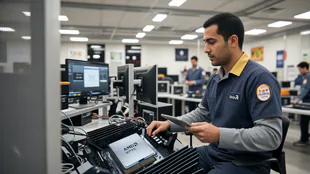
The Kometa system, manufactured by VNIIR-Progress, utilizes multiple receiving elements to sustain satellite connections when opposing forces transmit jamming signals. These components, technically referred to as patch antennas, enable drones to distinguish legitimate navigation data from electronic noise, thereby preserving their intended flight paths.
While Russia has previously deployed versions of the drone equipped with 16-element arrays and is preparing manufacturing lines for 20-element configurations, Ukrainian intelligence reports indicate that newer Shahed attack drones now carry significantly larger 32-element arrangements. These upgraded units have been identified during attacks on Kyiv.
Serhii Beskrestnov, an electronic warfare specialist advising President Volodymyr Zelenskyy on defense technology, explained the mechanical advantage of the upgrade. "The more elements, the more electronic-warfare signal sources the antenna can suppress," Beskrestnov stated. The 32-element configuration reportedly functions by combining two separate 16-element arrays, allowing the equipment to operate across different satellite navigation frequencies simultaneously.
The Kometa systems have already been integrated into a wide range of Russian military hardware, including Geran drones, guided aerial bombs, Iskander-M and Kinzhal missiles, as well as the newer Filin cruise missile. Ukrainian intelligence estimates that the recent order of over 100,000 modules covers multiple configurations across these weapon categories, suggesting an intent to distribute improved navigation protection broadly.
Despite the increased complexity of the antennas, Ukrainian specialists maintain that the drones are not immune to electronic countermeasures. The effectiveness of any Kometa configuration depends on its specific antenna arrangement, receiving elements, and the processing algorithms used to filter signals.
After acquiring a 32-element antenna through secondary weapons markets, Ukrainian experts claim to have identified vulnerabilities in the system. Alkhimik, commander of Ukraine’s Night Watch unit, outlined a counter-strategy involving dual-band jamming. "By creating two systems — one operating in the L1 band and the other covering L2/L5 — we’ll be able to jam this antenna without any problems," he said.
Another method under development involves satellite spoofing, which manipulates navigation data rather than simply overwhelming it with interference. Fly Group Ukraine has developed a countermeasure using connected devices that transmit fabricated coordinates to approaching Russian drones. This technique exploits the drone’s navigation system, potentially causing its autopilot to redirect the aircraft away from populated areas.
Anatoliy Khrapchynskyi, development director at Fly Group Ukraine, described the mechanism: "The drone continues to think it is flying toward its target, but its own autopilot, relying on the false coordinates, gradually changes course on its own and steers the craft away from cities into safe areas."
However, the long-term efficacy of these countermeasures remains uncertain as Russia continues to upgrade its equipment. If Ukrainian electronic warfare systems fail to reliably disrupt incoming drones with enhanced antennas, Kyiv may need to rely more heavily on interceptor aircraft, specialized drones, and costly missile defense systems.
The escalation in navigation module production highlights the ongoing technological arms race between Russian forces and Ukrainian defenders. As Moscow seeks to harden its weapons against interference, Ukraine is forced to adapt its electronic warfare tactics to maintain the integrity of its air defense networks.
A.Reynaud--MJ