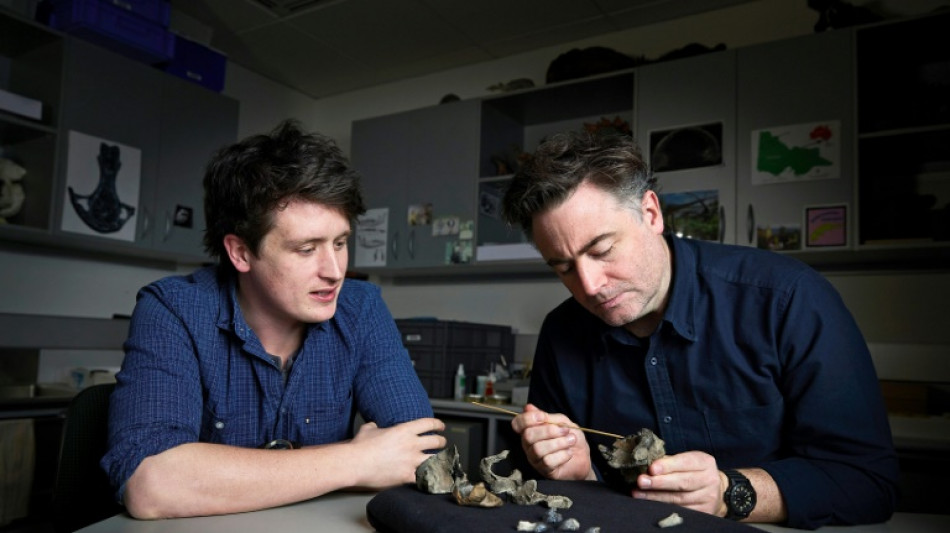
Scientists unearth 'cute' but fearsome ancient whale / Photo: Tom BREAKWELL - MUSEUMS VICTORIA/AFP

Australian scientists have discovered a razor-toothed whale that prowled the seas 26 million years ago, saying Wednesday the species was "deceptively cute" but a fearsome predator.
Museums Victoria pieced together the species from an unusually well-preserved skull fossil found on Victoria's Surf Coast in 2019.
Scientists discovered a "fast, sharp-toothed predator" that would have been about the size of a dolphin.
"It's essentially a little whale with big eyes and a mouth full of sharp, slicing teeth," said researcher Ruairidh Duncan.
"Imagine the shark-like version of a baleen whale -- small and deceptively cute, but definitely not harmless."
The skull belonged to a group of prehistoric whales known as the mammalodontids, distant smaller relatives of today's filter-feeding whales.
It is the fourth mammalodontid species ever discovered, Museums Victoria said.
"This fossil opens a window into how ancient whales grew and changed, and how evolution shaped their bodies as they adapted to life in the sea," said palaeontologist Erich Fitzgerald, who co-authored the study.
Victoria's Surf Coast lies on the Jan Juc Formation -- a geological feature dating to the Oligocene epoch between 23 and 30 million years ago.
A string of rare fossils have been unearthed along the scenic stretch of beach, a renowned site for the study of early whale evolution.
"This region was once a cradle for some of the most unusual whales in history, and we're only just beginning to uncover their stories," said Fitzgerald.
"We're entering a new phase of discovery.
"This region is rewriting the story of how whales came to rule the oceans, with some surprising plot twists."
The species was named Janjucetus dullardi, a nod to local Ross Dullard who stumbled across the skull while strolling the beach in 2019.
It was described in the peer-reviewed Zoological Journal of the Linnean Society.
V.Morandi--MJ