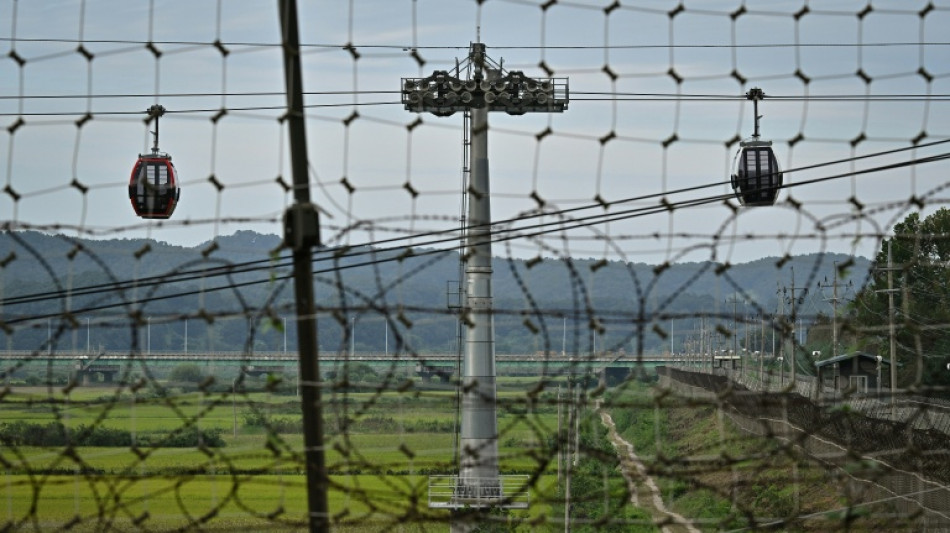
What we know about the North Korean POW dispute / Photo: Lillian SUWANRUMPHA - AFP

The transfer of two North Korean prisoners of war from Ukraine to South Korea has sparked a rare public diplomatic row between Seoul and Kyiv.
Seoul says the operation was meant to remain confidential, but Ukrainian President Volodymyr Zelensky revealed the transfer during an address to the United Nations last week -- prompting South Korea to demand an apology.
Here are five things to know about the dispute:
- Who are the two POWs? -
The two North Korean soldiers were captured by Ukrainian forces early last year after being deployed to Russia to fight alongside Moscow's troops.
They were among thousands of North Korean troops sent to support Russia's war against Ukraine, mainly in the Kursk border region, in exchange for economic and military assistance to Pyongyang.
One has said he was conscripted at 17 and served in a reconnaissance unit. Both expressed a wish to go to South Korea, which had also asked Kyiv to send them there.
Their transfer abruptly became public when Zelensky announced during his UN General Assembly speech that they had been transferred to South Korea.
Zelensky said the two were "not easy to capture alive" because North Korean troops often kill themselves rather than be taken prisoner.
"And this is how they raise people in the North... They drill into them that they must die," he said.
- Why is Seoul upset? -
South Korean President Lee Jae Myung said the two sides had agreed to keep the transfer confidential, as he described Zelensky's revelation as "very disappointing".
South Korea says both sides had reached a "clear understanding" during consultations to keep the transfer confidential, citing concerns for the safety of the POWs' families in North Korea.
Both POWs are identifiable as they had been photographed by South Korean media before their arrival to the South.
With the revelation, the families "are certain to face persecution in the North", Cho Seong-ryoul, a former policy adviser to the presidential national security office, told AFP.
- What will happen to the POWs? -
North Korean defectors are typically questioned by South Korea's intelligence agency upon arrival before being sent to Hanawon, a government resettlement institution, for about 12 weeks.
There, they learn how to navigate South Korean society and its market economy, from opening a bank account and driving to using the healthcare system.
Given their unusual circumstances, the two POWs are likely to be housed "separately from ordinary North Korean defectors, possibly at a secure, undisclosed facility or near a military hospital if they require treatment -- and I assume they probably do," Ahn Chan-il, a researcher originally from North Korea, told AFP.
"Defectors with sensitive backgrounds -- such as former intelligence operatives, diplomats or those with access to state secrets -- are typically kept separately from other arrivals."
- How will Pyongyang react? -
North Korea is known to retaliate against defectors and their families.
But Hong Min of the Korea Institute for National Unification said Pyongyang may choose to "let the incident pass", wary of the reaction from other families whose relatives were deployed to Russia.
If the North punishes the POWs' families and word spreads, it "could provoke unrest among the families of other soldiers", he said.
"With that in mind, Pyongyang may instead choose not to take action."
- How will this impact Seoul-Kyiv ties? -
South Korea has in recent years emerged as a major arms exporter -- particularly since Russia's invasion of Ukraine in early 2022 -- including through a multibillion-dollar arms deal with Poland.
But it has refrained from supplying Kyiv with lethal weapons, citing its longstanding policy of not arming countries engaged in active conflicts.
Kyiv has also sought South Korean air defence weapons, a request Seoul has not answered.
Lawmaker Yoo Yeong-ha said Wednesday that Seoul's spy agency believes Zelensky "may have decided to disclose the transfer" in the hope that it could "generate public support in Seoul for providing Ukraine with weapons and other forms of assistance."
But the ensuing row could make Seoul even more reluctant to do so, Lim Eul-chul, a professor at Kyungnam University, told AFP.
"Arms transfers require an extremely high degree of trust, and Zelensky's move could make Seoul even more cautious," he said.
S.Fontana--MJ