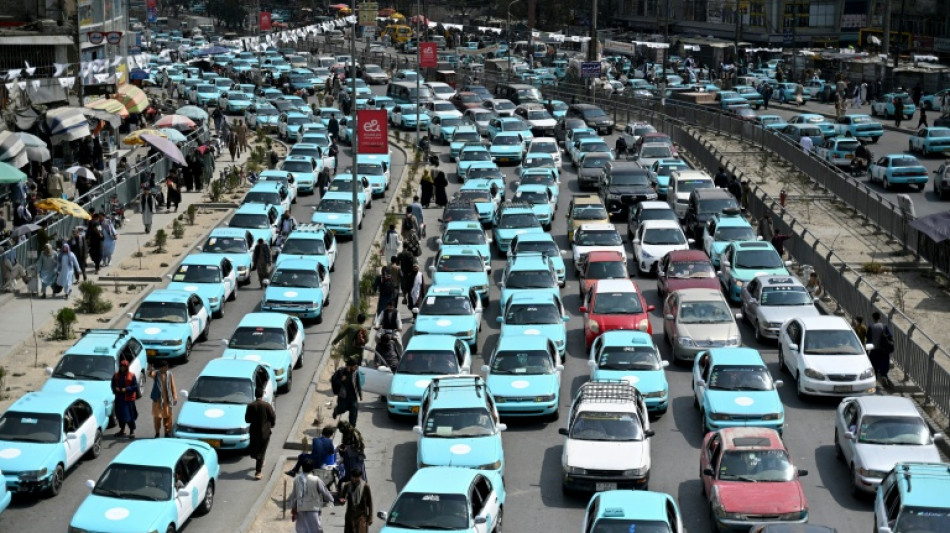
Rebellious Afghan taxi drivers defy ban on music / Photo: Wakil KOHSAR - AFP

Taxi drivers in Afghanistan are turning on the tunes in their cars, defying a ban imposed by the Taliban government despite the fear of getting caught by morality police.
The music that used to flow constantly out of restaurants, cafes and shops in the capital Kabul has been muted for five years, replaced only by religious or patriotic songs supported by the Taliban authorities in power since 2021.
But taxi drivers such as Roeen have started playing Afghan and regional folk or pop music, which they quickly turn off when security forces may be around.
"At every checkpoint we pass, we lower the volume of the music or even turn it off completely... so I don't get into trouble with them," said Roeen, who gave only his first name for security reasons.
The ban on music in public places is imposed by the Propagation of Virtue and the Prevention of Vice (PVPV) Ministry, whose morality police roam the city wearing long white coats.
PVPV regulations state that "since music is forbidden and causes annoyance to passengers, drivers must refrain from playing or listening to it".
The ministry did not respond when asked to comment on punishments Afghans face for playing music, but those breaching their various other rules risk being jailed.
Roeen said PVPV officials have "a lot of authority".
"We're definitely too afraid of them to be able to listen to music at a higher volume," he told AFP in his sky blue-and-white taxi.
Driving through the heavy traffic and noisy roads of Kabul, Roeen said he has "become 10 times more interested in music" since the ban.
"I have to make sure that even if I can't listen in the early morning, by eight o'clock my music is on," he said.
In a country where various forms of entertainment including cinema are outlawed, listening to music constantly is a "form of protest" for the 28-year-old driver.
- 'Stress' and no headphones -
Another taxi driver, who requested anonymity for security reasons, told AFP he only listens to music when he is alone in his car and surrounded by the noise of other vehicles.
"Before, whenever a person wanted, they could listen without any worry or stress. But now... personally I listen -- but with some stress," he said in his car that had a radio player with a USB slot.
The 32-year-old has been stopped twice at checkpoints for having a USB stick and a memory card.
"I didn't lie -- I said it has music, and they broke it," he said.
"Afghan culture should not vanish, and music is one of the cultures of our people. Personally, I don't want this culture to disappear."
As part of their crackdown on banned music, the PVPV's provincial departments occasionally report burning instruments. No figures are available on how many they have seized, according to ministry spokesman Saiful Islam Khyber.
Across the capital, residents use shared taxis as an affordable way to get around a city which lacks a proper public transport system.
Often, two passengers sit alongside the driver in the front, three are in the back, and sometimes someone rides in the open boot.
Shamsullah Ahmad, a master's student, spoke to AFP while waiting for a taxi near his university.
"I prefer to listen to music every day; whenever I go to any destination, I try to check if the taxi has a music player," said the 29-year-old.
"I prefer music in the car, because wearing headphones would be noticed, but in the car, even with lower volume is better than nothing," Ahmad said.
The morality police have been known to take headphones out of Afghans' ears to check if they are listening to music.
Roeen, the driver, misses the days when "we could listen to songs, dance, and celebrate, and no one would stop us".
But now the city is "shrouded in darkness -- a darkness devoid of any light", he said, above the din of growling engines.
C.Durand--MJ