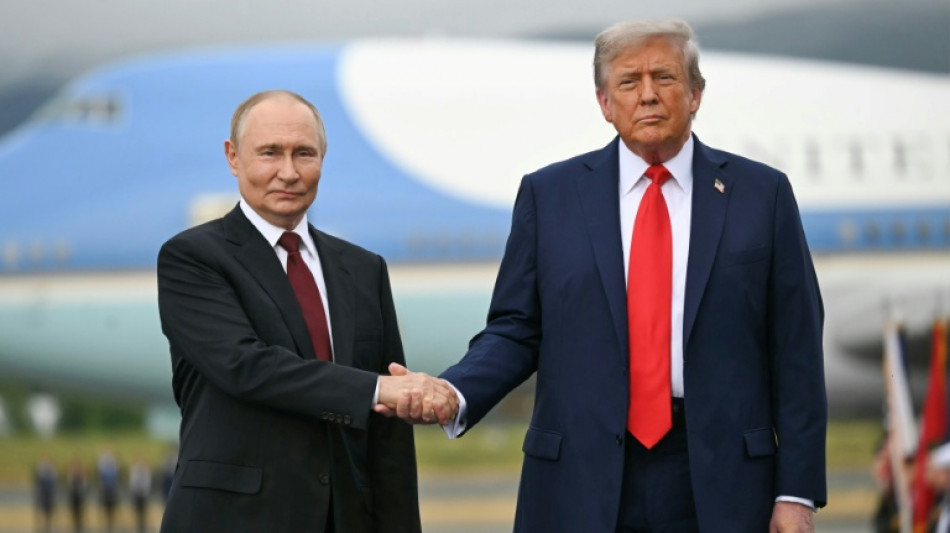
One year after Putin-Trump summit, 'spirit of Anchorage' dissipated / Photo: ANDREW CABALLERO-REYNOLDS - AFP

In the year since Donald Trump hosted Vladimir Putin on US soil for a summit designed to broker an end to Russia's offensive on Ukraine, the diplomatic initiative has fizzled out and the conflict has escalated.
For months, Russian officials talked up the "spirit of Anchorage" -- a supposed climate of detente, renewed dialogue with Washington and a framework for finding a way out of the deadliest European conflict since World War II.
Now there are few traces of that atmosphere. US mediation efforts are at a standstill, both Russia and Ukraine are ramping up attacks and more civilians are being killed than at any point since the first months of the war.
- 'Ending the war'-
On August 15, 2025, Trump broke with the West's policy of isolating Putin, rolling out the red carpet as the Kremlin chief stepped off his plane at the Elmendorf-Richardson air base in Alaska.
It remains unclear what was decided or discussed behind closed doors.
Russia has always maintained some kind of understanding on a peace deal was struck -- "a compromise proposal", as Foreign Minister Sergei Lavrov called it.
Washington has rebuffed any talk of a deal being reached.
"There was a proposal in Alaska, but there was no agreement. If there had been an agreement, we would have had an end of the war," Secretary of State Marco Rubio said in June.
Moscow had hoped the summit would lay the foundations for a "lasting peace" by addressing what it calls the "root causes" of the conflict, said political analyst Sergei Markov -- designated a "foreign agent" but still close to the Russian authorities.
For years -- including right before launching its offensive in February 2022 -- Russia has called for a new overarching security deal with the United States over Europe, NATO and arms control.
The "compromise" Russia tabled in Alaska, Markov told AFP, was to limit its territorial claims on Ukraine to the eastern Donbas region in exchange for recognition of Russia's new borders by Washington and the lifting of sanctions.
- Disenchantment -
Those Russian demands were included in a 28-point document drafted by the United States -- later cut down to 19 -- after separate negotiations with Kyiv and Moscow.
The document was never published officially and never came to fruition.
US-brokered direct talks between Russia and Ukraine in early 2026 broke down, chiefly over the issue of territory.
Ukraine refuses to cede land it still controls and wants an immediate ceasefire along the current front line, with territorial status to be decided during fuller peace talks.
And since late February, Washington's attention has been consumed by the war on Iran.
Trump has since issued fresh sanctions on Russia and the last remaining nuclear arms control agreement -- New Start -- has been allowed to lapse.
Having once sensed a window of opportunity to press its demands and been at pains to praise Trump's efforts, Russia has lately allowed itself to publicly question Washington's commitment to diplomacy.
"I don't even want to imagine that Alaska ... was conceived to gain time in order to strengthen Ukraine militarily," Lavrov said in June.
A meeting between Lavrov and Rubio in Manila in July -- their first since September 2025 -- lasted only around 30 minutes.
"We'll have to find new suggestions and new ideas" that both "Russia and Ukraine can agree to," Rubio said after that meeting.
"That's going to require a lot of work," he added.
- Escalation -
The two sides' conditions for peace are irreconcilable.
Russia demands territory alongside political and military concessions that Ukraine rejects as capitulation.
At the same time, both are convinced force can improve their negotiating position.
"The Russian armed forces will continue their mission to liberate the Donbas and Novorossiya in line with the approved plan," Russia's army chief Valery Gerasimov told Putin in a televised meeting in early July -- referring to land stretching across eastern and southern Ukraine.
Buoyed by European support, Kyiv is banking on its long-range strike campaign to tip Russia's economy and society over the edge.
Its attacks triggered a nationwide fuel crisis over the summer, and have forced Moscow-installed authorities to put the annexed Crimean peninsula under a local "state of emergency".
Russia has upped its missile attacks on Kyiv, killing dozens there in recent weeks.
It has also brought Ukrainian exports through the Black Sea to a standstill through a campaign of port and ship strikes.
"The spirit of Anchorage has dissipated," said Russian political analyst Fyodor Lukyanov -- close to the ruling elite -- in August.
The result? "Brutal escalation."
F.Petit--MJ