Trump tells AFP Iran deal 'very close' as Hormuz reopens
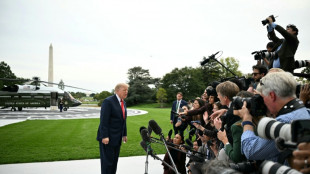
US President Donald Trump told AFP on Friday that a peace deal with Iran was "very close" and had "no sticking points," as Tehran declared the Strait of Hormuz open to commercial shipping.
The upbeat signals from Washington came as a ceasefire took effect in Lebanon, raising hopes that two of the main obstacles to a US-Iran agreement may have been removed.
"We're very close. Looks like it's going to be very good for everybody. And we're very close to having a deal," Trump said in a brief telephone call with AFP from Las Vegas, adding there were "no sticking points at all" left with Tehran.
"The strait's going to be open, they already are open. And things are going very well."
But Tehran quickly pushed back on one key point. Iran's foreign ministry said Friday that its stockpile of enriched uranium would not be transferred "anywhere," rejecting an earlier claim by Trump that the Islamic republic had agreed to hand it over.
Trump's comments to AFP followed a series of social media posts touting progress on reopening the key waterway -- through which about a fifth of global crude oil and liquefied natural gas passes in peacetime -- and ending Iran's nuclear program.
He hailed a "GREAT AND BRILLIANT DAY FOR THE WORLD!" in celebratory posts praising mediator Pakistan and Gulf allies, while telling NATO to "STAY AWAY" as he rejected the alliance's offer to help secure the Hormuz strait.
After the truce took hold in Lebanon, Iranian Foreign Minister Abbas Araghchi said the Islamic republic would lift its blockade on shipping through the key Gulf energy route.
"In line with the ceasefire in Lebanon, the passage for all commercial vessels through Strait of Hormuz is declared completely open for the remaining period of ceasefire," Araghchi said.
Military vessels remain banned from the waterway, a senior Iranian military official told state media.
UN chief Antonio Guterres called the reopening "a step in the right direction" and urged full freedom of navigation through the waterway.
- Fragile gains -
Trump warned, however, that the US blockade of Iran's ports -- which the US military says has turned back 19 ships so far -- would continue until a deal was reached.
Iranian navy chief Shahram Irani denied that in a video posted by the Fars news agency.
"We are not blockaded. Today and every day, ships that respect customs...pass through," he said.
Oil prices had already been falling on hopes of a negotiated end to the conflict, and the drop accelerated sharply after Iran's announcement.
The ceasefire in Lebanon and the reopening of the strait marked key progress in Washington's push for a broader deal to end its war with Iran, after Tehran insisted that halting the Lebanon fighting must be part of any agreement.
In Lebanon, displaced families used the 10-day truce to return to homes in bomb-damaged south Beirut and the war-ravaged south.
"Our feelings are indescribable, pride and victory," 37-year-old Amani Atrash told AFP, adding that she hoped the ceasefire would be extended.
Trump said Israel had been "prohibited" by Washington from carrying out further strikes.
"Enough is enough!" he said, adding that the United States would work with Lebanon "and deal with the Hezbollah situation in an appropriate manner."
But shortly after Trump's post, Lebanese state media said an Israeli drone strike killed a motorcyclist in Kunin in southern Lebanon. The Israeli military did not immediately comment.
The fighting in Lebanon began on March 2, when Hezbollah fired rockets at Israel days after the wider Middle East war began and in retaliation for the killing of Iran's supreme leader Ali Khamenei.
- Truce under strain -
Separately, the Israeli military said it was lifting wartime restrictions, though Prime Minister Benjamin Netanyahu warned that the campaign against Hezbollah was not over.
"We have not yet finished the job," he said, adding that a key objective was the "dismantling of Hezbollah."
Minutes before the ceasefire took effect at midnight, Israeli strikes on the southern Lebanese city of Tyre killed at least 13 people, a city official said.
Under the truce, Israel reserves the right to continue targeting Hezbollah to prevent "planned, imminent or ongoing attacks," and says it will maintain a six-mile (10-kilometer) security zone along the border in southern Lebanon.
Israeli Defense Minister Israel Katz said military action could resume if the area between this security zone and the Litani River was not "cleared of terrorists and weapons."
According to details released by the US State Department, Lebanon "will take meaningful steps to prevent Hezbollah" from attacking Israeli targets.
Lebanese President Joseph Aoun said Friday his country was no longer "an arena for anyone's wars."
He added that Lebanon was on the verge of a "new phase" of "permanent agreements" and would not accept any deal that infringed on its rights.
Earlier, he said Beirut's goal was to "consolidate a ceasefire, secure the withdrawal of Israeli forces...recover prisoners and address outstanding border disputes."
Hezbollah, meanwhile, said its finger remained "on the trigger" in case of any Israeli violations.
burs-ft/sla
F.Gentile--MJ