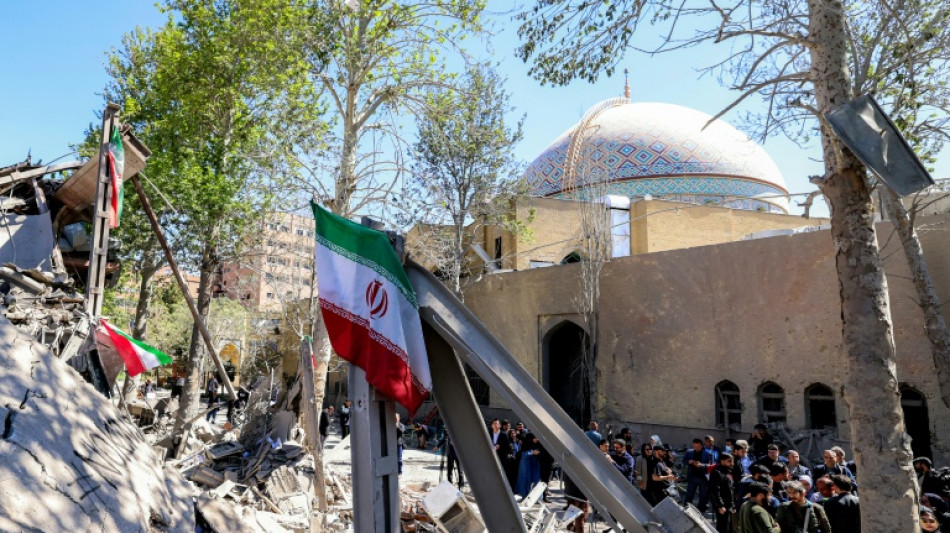
Key infrastructure in Iran hit ahead of Trump deadline / Photo: ATTA KENARE - AFP

Iran said critical infrastructure, including two bridges, was struck Tuesday by the United States and Israel, with US President Donald Trump warning "a whole civilisation will die" if a midnight deadline for a deal to open the Strait of Hormuz was not met.
The strikes came as Iran's Revolutionary Guards warned they would deprive the United States and its allies of oil and gas if Washington crossed Tehran's "red lines".
Trump had warned that unless Tehran allowed free passage through the strategic oil chokepoint by midnight GMT, the United States would unleash what he called the "complete demolition" of Iran's critical infrastructure, including bridges and power plants.
But hours before that deadline, the Israeli military said that it had already completed a broad wave of strikes targeting "infrastructure sites" across Iran.
Trump meanwhile elevated his threat, writing on Truth Social that "a whole civilisation will die tonight, never to be brought back again. I don't want that to happen, but it probably will", if the country did not heed his ultimatum.
Iranian authorities reported a US-Israeli attack on a bridge outside the city of Qom and a strike on a rail bridge in central Iran that killed two people.
Regional authorities also said that a US-Israeli strike shut down a key highway in northern Iran connecting the city of Tabriz with Tehran.
The Mizan news agency additionally reported a strike on railway tracks in Karaj, outside Tehran.
Ahead of those strikes, university student Metanat, whose classmate was killed two weeks ago in an attack, told AFP that she was "terrified and so should everyone else in the country be".
The 27-year-old, who declined to give her last name, said as far as Trump's ultimatums were concerned, "some people think they are a joke", but "death is not a joke".
The Iranian military has previously dismissed what it called Trump's "arrogant rhetoric and baseless threats", saying they would not hinder its operations.
Alireza Rahimi, Secretary of the Supreme Council of Youth and Adolescents of Iran, called on young people to form human chains around power plants across the country.
On Tuesday the Israeli military told Iranians to avoid taking trains until 1730 GMT, and train travel to and from Iran's second city of Mashhad was cancelled until further notice.
In the Gulf, the King Fahd Bridge, a major artery connecting Saudi Arabia and the island nation of Bahrain, was temporarily closed as a precaution amid fears of retaliatory strikes by Iran.
- Explosions -
Strikes were also reported on Kharg island, a critical hub for the Iranian oil industry, according to Iran's Mehr news agency, although a journalist for the US publication Axios said the attack was against "military targets".
Earlier in the day a series of explosions was heard across Tehran, and Iranian media reported that 18 people, including two children, were killed in strikes in Alborz province neighbouring the capital.
US-Israeli strikes also "completely destroyed" the capital's Rafi-Nia synagogue, local media reported.
Iranian media said explosions were heard in parts of the capital and nearby Karaj.
The Israeli army later said it had detected missiles launched from Iran towards Israeli territory, adding that air defence systems were working to intercept them.
Overnight, attacks on Saudi Arabia hit a petrochemical complex in a sprawling industrial area in the eastern city of Jubail, a witness who requested anonymity told AFP, hours after similar installations in Iran were struck.
- Ceasefire proposal rejected -
Both Trump and Iran have said a proposal touted by international mediators for a 45-day ceasefire is not yet ready.
Trump had said earlier that the plan, which is being mediated by Pakistan, Egypt and Turkey, was a "significant proposal", but he later went on to say it was not good enough.
Iranian state media quoted officials as saying that Tehran too "has rejected a ceasefire and insists on the need for a definitive end to the conflict".
Under the plan, Iran would reopen the strait while charging around $2 million per vessel, a fee it would share with neighbouring Oman, the New York Times reported.
On the diplomatic front, the UN Security Council is set to vote on Tuesday on a watered-down resolution addressing Iran's threats to the strait, diplomatic sources told AFP, after more robust earlier drafts were derailed by the possibility of vetoes.
Iran has effectively blocked the strait since the start of the war on February 28, driving up global oil and gas prices. Around one‑fifth of the world's oil normally flows through the strait.
burs-bfm/dcp
P.Michel--MJ