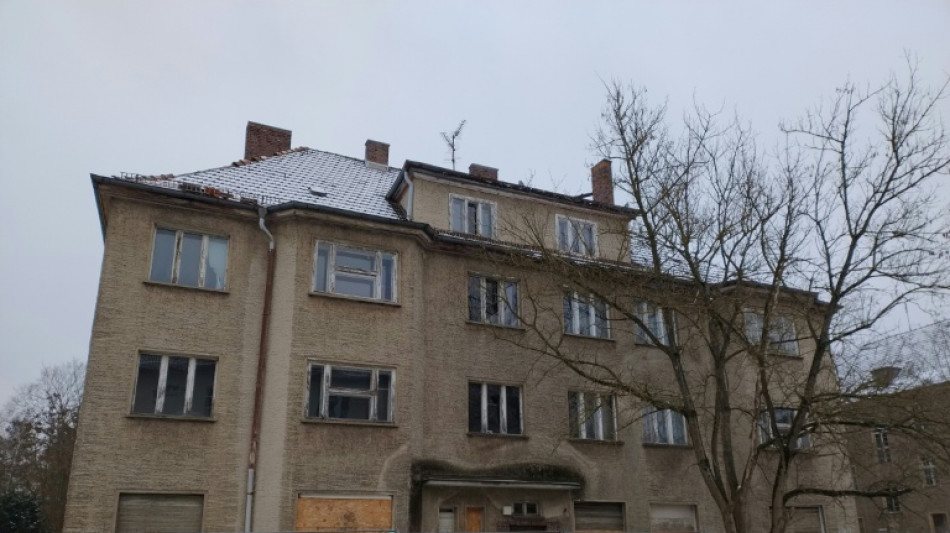
Berlin's crumbling 'Russian houses' trapped in bureaucratic limbo / Photo: Jastinder KHERA - AFP

The thorny issue of what to do with Russian assets has not only stumped Western leaders but also officials in Berlin who are saddled with three crumbling buildings belonging to Moscow.
Known locally as the "Russian houses", they sheltered Soviet soldiers and their families in the eastern neighbourhood of Karlshorst, the site of the Nazis' final capitulation, which then housed the Soviet military's headquarters in communist East Germany.
Since the last Russian soldiers left in 1994, the apartment blocks have stood empty and untouched, even after Moscow was hit with waves of European sanctions over its 2022 full-scale invasion of Ukraine.
Germany has been Ukraine's second-biggest backer, and diplomatic relations between Berlin and Moscow are in the freezer.
Other Russia-linked property in Germany, such as the subsidiaries of oil giant Rosneft, have also been in limbo, with the fear of retaliation hanging over any attempt to seize them.
Only raccoons are said to live in the Karlshorst buildings and birch saplings are sprouting out of a balcony.
Karlshorst's representative in the assembly of the city-state of Berlin, Ukrainian-born Lilia Usik, has over the past two years been trying to ascertain if the buildings can be seized or possibly used to help Ukraine.
Usik says locals have "asked again and again: 'What's happening with the houses? Can you do something about them?'"
But tricky questions around property rights and multiple layers of bureaucracy mean there is no sign of a quick resolution.
- Pass the parcel -
Despite her energetic enquiries to several layers of officialdom within Germany and beyond, Usik says she "hasn't been able to find a solution".
It is not clear what German authorities want to do and any attempt to get clarity turns into a game of bureaucratic pass the parcel.
The foreign ministry says the buildings do not have protected diplomatic status and Russia has "the same rights and responsibilities as any other owner".
Berlin's city government says it can only use the houses if there is "a willingness on the part of Russia" to hand them over, telling AFP that "at the moment this is not in evidence".
It approached the Russian embassy in 2020 to see if Moscow was willing to sell them but received no reply.
Some have asked why they cannot be seized under laws meant to prevent homes standing empty or becoming uninhabitable -- particularly in a city with a housing shortage.
Berlin city's government says confiscating the properties on these grounds would be the job of the Lichtenberg city district that takes in Karlshorst.
Further complicating matters, one of the buildings is listed as a heritage-protected monument.
Contacted by AFP, the Lichtenberg district council would only say it is "coordinating with the city authorities and the foreign ministry".
Usik, a Russian speaker, says she has noted a "very aggressive" tone in the Russian press when the houses are discussed.
The Russian embassy in Berlin, when asked for its position on the houses by AFP, declined to comment.
R.Santoro--MJ