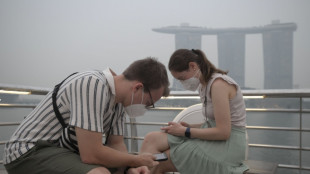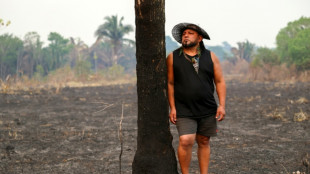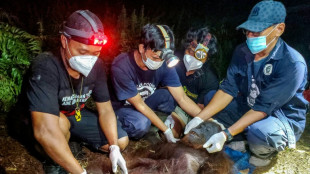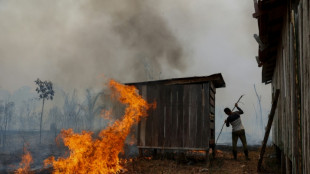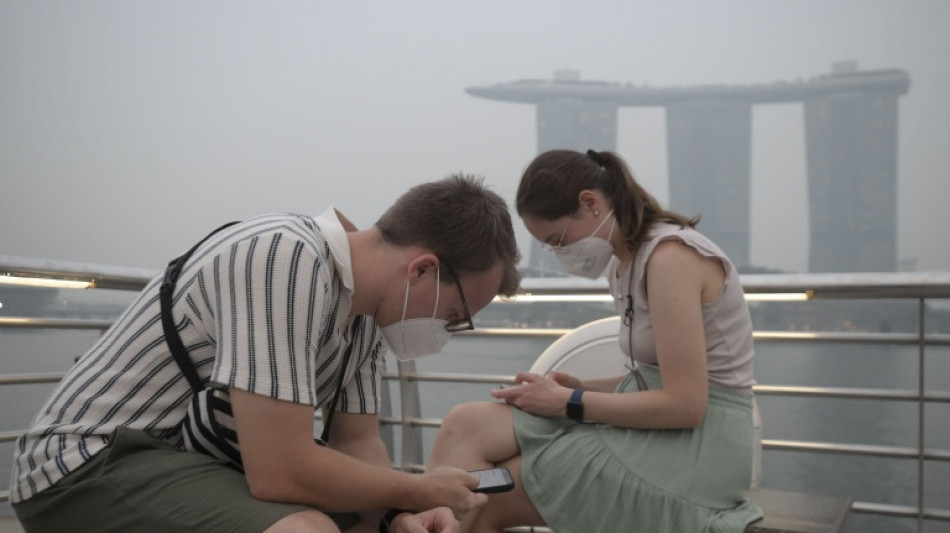
Four killed in Indonesia battling fires causing toxic haze / Photo: FELINE LIM - AFP

Four people died on Indonesia's Java island fighting the blazes that have been sending toxic smoke across southeast Asia, closing schools and fuelling a surge of respiratory complaints in the region, authorities said Friday.
The impact of the months-long fires has prompted Singapore's leader to vow legal action against any companies responsible for the blazes that have made regional air quality among the world's worst.
Singapore again topped IQAir's live ranking of the world's most polluted major cities on Friday, with Kuala Lumpur second and Jakarta sixth.
"Where warranted, we will take action under Singapore's Transboundary Haze Pollution Act, and also explore joint action with other countries," said Singapore Prime Minister Lawrence Wong, without giving further details.
Singapore has no plantations or forests of its own, but several companies with concessions in Indonesia are reportedly based in the city-state.
Legal experts have cautioned that pursuing companies linked to the smoke is challenging, with investigations reliant on cooperation from foreign authorities.
Singapore enacted the Transboundary Haze Pollution Act in 2014, after a severe pollution episode in 2013. Another spell occurred in 2015.
The law allows authorities to target companies whose activities overseas cause or contribute to unhealthy haze levels in Singapore.
Establishing responsibility is challenging because it requires authorities to share maps pinpointing fire hotspots, with overlapping land claims further complicating matters.
Singapore's investigations into four Indonesian companies over their alleged role in the 2015 haze crisis remain open, a case that strained relations with Jakarta at the time.
Other chances for legal action, including a possible case at The Hague-based International Court of Justice, were also low as it needed Indonesia's consent for jurisdiction in the case.
- 'Do everything we can' -
Singapore's air pollution surged to 251 on IQAir's Air Quality Index level into very unhealthy levels at around 0400 GMT on Friday.
Under the Swiss-based company's system, readings of 151-200 are considered unhealthy, 201-300 very unhealthy and above 300 hazardous.
"We cannot control the weather or the winds, nor can we directly control what happens beyond our borders," said Wong.
"But we will do everything we can to protect Singaporeans, while working with our neighbours to address the underlying causes of the haze."
The smoke is a direct consequence of the fires, which four people lost their lives battling in East Java's Bromo Tengger Semeru National Park on Thursday, Indonesia's forestry ministry said in a statement.
Two others suffered serious burns and are receiving further medical treatment.
"This incident serves as a reminder that forest and land fire extinguishing is a high-risk operation," it said, adding personnel safety remained a primary concern.
The forestry department in the same statement said there was a significant jump in hotspots in several areas in six "priority provinces" where 615 so-called hotspots were detected.
A hotspot is a location where a satellite detects an unusually high temperature, indicating a potential fire or other strong heat source.
burs-jhe/jm
C.Battaglia--MJ