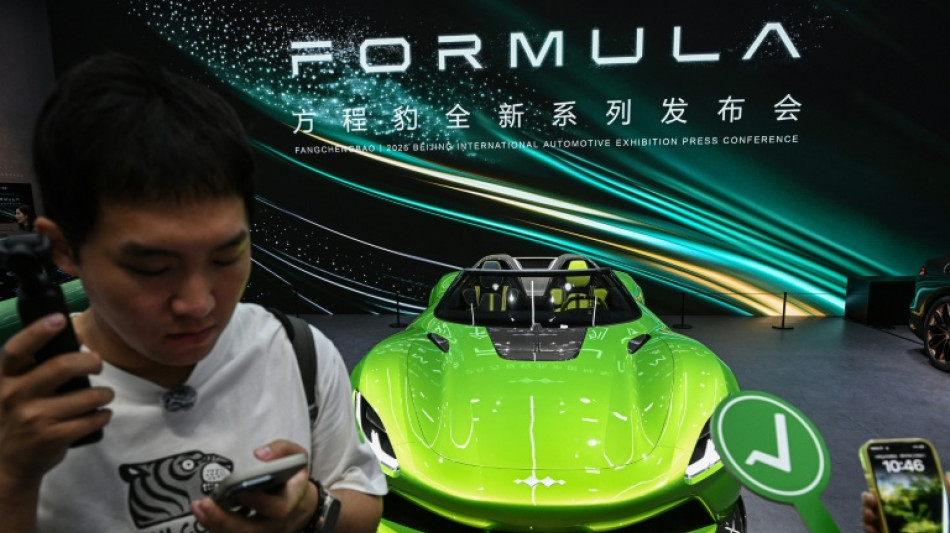
Chinese EV makers take centre stage at world's biggest auto show / Photo: JADE GAO - AFP

Thousands snapped selfies beside sleek Chinese electric vehicles on Friday at the world's biggest car show in Beijing, where automakers are seeking to lure buyers in a cut-throat market.
Rows of influencers posed in front of gleaming models at the cavernous international exhibition centre in the capital, darting to suitcases stuffed with outfit changes, while animated CEOs worked the crowds in front of massive LED screens.
Legacy overseas brands such as Volkswagen, Toyota and BMW once dominated in China, but have lost market share in past years to domestic firms that beat them to the electric vehicle revolution and undercut them on price.
Chinese manufacturers including BYD, Xiaomi and Xpeng are now also at the forefront of integrating AI software and autonomous driving technology into their EVs.
The Auto China exhibition, hosted at two side-by-side venues, spans 380,000 square metres (four million square feet), according to organisers -- more than 50 football pitches.
More than 1,400 vehicles from hundreds of Chinese and foreign companies are on display from Friday, when the show opened to industry professionals and the media, and later to the public from April 28 until May 3.
At the sprawling expo, crowds cheered as XPeng chief executive He Xiaopeng took the stage beside the Chinese company's latest model, the GX, a six-seat electric SUV.
The imposing 5.2-metre vehicle incorporates AI technology and is aiming at breaking into the luxury market, He said.
It would soon be followed by humanoid robots this year, He promised, and eventually by flying cars, which XPeng hopes to mass-produce.
Foreign automakers are increasingly collaborating with Chinese firms to keep pace with technological advances.
BMW has partnered with Chinese battery maker CATL, while Audi is using Huawei's driving assistance systems and Volkswagen is developing EVs together with Guangzhou-based Xpeng.
XPeng President Brian Gu told reporters that companies were "leveraging their respective strength to collaborate with China" a trend he said would continue both domestically and overseas.
Gu has his eyes set on export markets including Europe and the Gulf. Asked by AFP how Trump's tariffs were affecting Xpeng, he said only that the US market remained an important one.
- Fierce competition -
This year, companies are also jostling to sell space, analysts say, with roomy SUVs' new growth area targeting customers prioritising seating and comfort.
China "has become a customer retention and replacement/upgrade-driven market, and these big SUVs address that need," independent analyst Lei Xing wrote in a blog this week.
Firms have flooded the domestic market in recent years with trade-in schemes, offering huge discounts to customers to give up their old car for a new one.
The fierce price war led Chinese officials last year to call for tighter price monitoring and improving long-term regulation of competition.
But newcomers appear unfazed, Lei wrote, naming at least eight EV brands from Chinese automakers that have cropped up over the last two years.
Electric vehicles, an area China dominates, are also gaining traction as rising global oil prices linked to the Middle East war push drivers away from fossil fuel-powered models.
Manufacturers are now competing on driving range.
Xiaomi chief executive Lei Jun recently completed a 1,300-kilometre (800-mile) trip from Beijing to Shanghai in the SU7 Pro electric sedan, stopping only once to recharge during the 15-hour drive.
G.Mancini--MJ