Ziggy Stardust lives on at David Bowie London immersive / Photo: Henry NICHOLLS - AFP

Silhouetted against the light on stage in 1990, David Bowie belts out a deafening rendition of "Rebel Rebel" as a rapturous audience claps along with arms raised.
Rewind to 1973 and the iconic star is on stage at London's Hammersmith Odeon singing "Rock 'n' Roll Suicide" in his last show as Ziggy Stardust.
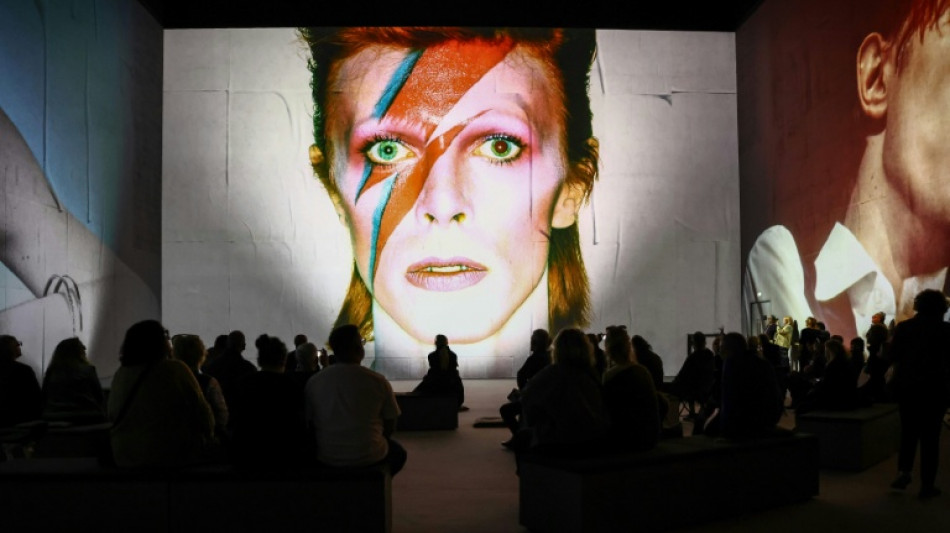
A decade after Bowie died in 2016 in New York at the age of 69, these are just some of the spellbinding moments captured in a new immersive, multi-media feature at London's Lightroom venue which opened Wednesday.
The show features Bowie performing live, including previously unseen footage, alongside rarely heard interviews.
It is the latest project dedicated to the singer, widely considered one of the most influential artists of the 20th century.
At the "cathedral-like" Lightroom, images and footage are projected on to 11-metre (36-feet) high screens on all four walls as well as the floor.
Combined with a 360-degree sound system it's ideal for conveying Bowie's "genius as a live performer" and creating a sense of being there in the audience, according to writer and director Mark Grimmer.
"It's a social event. It's a crowd of people, you're there with other human beings," Grimmer told AFP.
For the show, Grimmer and co-director Tom Wexler ploughed through countless hours of footage in the vast Bowie archive.
Highlights of "David Bowie: You're Not Alone" include the star's Hammersmith Odeon performance.
The concert famously featured in the DA Pennebaker film "Ziggy Stardust: The Motion Picture" (1983) which saw Bowie kill off the Ziggy persona.
- Icon and human being -
Another highlight is a 1978 performance of "Heroes" at London's Earl's Court when Bowie "was really at the peak of his power," Grimmer said.
Other footage includes Bowie at Live Aid in 1985 and performing "Starman" on the BBC chart programme Top of the Pops in 1972 dressed in a typically outlandish rainbow jumpsuit and boots.
Intercut with the footage is plenty of Bowie in his own words.
The singer, who had his first major hit with "Space Oddity" in 1969, describes the bleakness of his London childhood and his search for "colour, exhilaration" and a "way out".
"I think one of the things that we wanted to do is to give an insight into Bowie the human being, as well as Bowie the icon," said Grimmer.
After listening to some of the many interviews he gave, what emerged was a "very humorous and self-deprecating" character, he added.
Bowie laughs as he describes himself as an "unlikely" rock star, compares himself to an "emperor penguin" and admits to a burning curiosity about everything in life "except country and western (music), of course".
Grimmer also focuses on Bowie's creative process which saw him endlessly reinvent himself.
- 'Float on life' -
Essentially a "shy person", Bowie, whose birth name was David Jones, struggled with performing on stage in the early years.
To overcome his inhibitions he would immerse himself in the characters he created such as the androgynous alien rock star Ziggy Stardust sent to Earth before an apocalypse.
When all the "theatrics" were removed, Bowie said he was basically a writer who gravitated towards the isolated and freakish "not regular guys".
"I'm a writer, that's what I do," he said.
The hour-long show, which runs until at least October, features some 40 tracks by Bowie who sold at least 100 million records worldwide during his lifetime.
Reflecting on the ageing process, it draws to a close with him talking about his belief in an "energy form".
"You float on life when you get older, you're not quite sure which way up it all is, which is not uncomfortable."
"I'm quite happy in chaos," he added, concluding that "life and the universe" was "really untidy".
A.Lorenzi--MJ